This demo presents the track REST-CXF of minuteproject.
The model from demo 2 remains the same.

The enrichment stays the same.
But the tracks changes
What is added are 2 layers:
- a DAO layer with spring integration on top of JPA2
- a REST-CXF layer with JAX-RS annotation
All this is done to provide a CRUD interface on top of the model entities.
Configuration
Here is the configuration TRANXY-JPA2-Spring-REST-CXF.xml<!DOCTYPE root>
<generator-config xmlns="http://minuteproject.sf.net/xsd/mp-config"
xmlns:xs="http://www.w3.org/2001/XMLSchema-instance"
xs:noNamespaceSchemaLocation="../config/mp-config.xsd">
<configuration>
<conventions>
<target-convention type="enable-updatable-code-feature" />
</conventions>
<model name="tranxy" version="1.0" package-root="net.sf.mp.demo">
<data-model>
<driver name="mysql" version="5.1.16" groupId="mysql"
artifactId="mysql-connector-java"></driver>
<dataSource>
<driverClassName>org.gjt.mm.mysql.Driver</driverClassName>
<url>jdbc:mysql://127.0.0.1:3306/tranxy</url>
<username>root</username>
<password>mysql</password>
</dataSource>
<primaryKeyPolicy oneGlobal="false" >
<primaryKeyPolicyPattern name="autoincrementPattern"></primaryKeyPolicyPattern>
</primaryKeyPolicy>
</data-model>
<business-model>
<generation-condition>
<condition type="exclude" startsWith="QUARTZ"></condition>
</generation-condition>
<business-package default="tranxy">
<condition type="package" startsWith="trans" result="translation"></condition>
</business-package>
<enrichment>
<conventions>
<!-- manipulate the structure and entities BEFORE manipulating the
entities -->
<column-naming-convention type="apply-strip-column-name-suffix"
pattern-to-strip="ID" />
<reference-naming-convention
type="apply-referenced-alias-when-no-ambiguity" is-to-plurialize="true" />
</conventions>
<entity name="language_x_translator">
<field name="language_id" linkReferenceAlias="translating_language" />
<field name="user_id" linkReferenceAlias="translator" />
</entity>
<entity name="LANGUAGE_X_SPEAKER">
<field name="LANGUAGE_ID" linkToTargetEntity="LANGUAGE"
linkToTargetField="IDLANGUAGE" linkReferenceAlias="spoken_language" />
<field name="user_id" linkReferenceAlias="speaker" />
</entity>
<entity name="APPLICATION">
<field name="TYPE">
<property tag="checkconstraint" alias="application_type">
<property name="OPENSOURCE"/>
<property name="COPYRIGHT" />
</property>
</field>
</entity>
</enrichment>
</business-model>
</model>
<targets>
<target refname="REST-CXF-BSLA"
name="default"
fileName="mp-template-config-REST-CXF-Spring.xml"
outputdir-root="../../DEV/latvianjug/tranxy/rest"
templatedir-root="../../template/framework/cxf">
</target>
<target refname="BackendOnBsla"
name="default"
fileName="mp-template-config-JPA2-bsla.xml"
outputdir-root="../../DEV/latvianjug/tranxy/bsla"
templatedir-root="../../template/framework/bsla">
<property name="add-cache-implementation" value="ehcache"></property>
</target>
<target refname="JPA2" fileName="mp-template-config-JPA2.xml"
outputdir-root="../../DEV/latvianjug/tranxy/jpa"
templatedir-root="../../template/framework/jpa">
<property name="add-querydsl" value="2.1.2"></property>
<property name="add-jpa2-implementation" value="hibernate"></property>
<property name="add-cache-implementation" value="ehcache"></property>
<property name="add-domain-specific-method" value="true"></property>
<property name="add-xmlbinding" value="true"></property>
<property name="add-xml-format" value="lowercase-hyphen"></property>
</target>
<target refname="MavenMaster"
name="maven"
fileName="mp-template-config-maven.xml"
outputdir-root="../../DEV/latvianjug/tranxy"
templatedir-root="../../template/framework/maven">
</target>
<target refname="CACHE-LIB" fileName="mp-template-config-CACHE-LIB.xml"
templatedir-root="../../template/framework/cache">
</target>
<target refname="LIB" fileName="mp-template-config-bsla-LIB-features.xml"
templatedir-root="../../template/framework/bsla">
</target>
<target refname="REST-LIB"
fileName="mp-template-config-REST-LIB.xml"
templatedir-root="../../template/framework/rest">
</target>
<target refname="SPRING-LIB"
fileName="mp-template-config-SPRING-LIB.xml"
templatedir-root="../../template/framework/spring">
</target>
</targets>
</configuration>
</generator-config>
It is possible to enrich each link of the many-to-many relationship table (ex: language_x_translator and language_x_speaker) to provide the other side relationship with an alias and thus avoid long composite variable name.
Generation
Set TRANXY-JPA2-Spring-REST-CXF.xml inRun
>model-generation.cmd TRANXY-JPA2-Spring-REST-CXF.xml
The output goes in
Resulting artefacts
A maven project structure with 3 modules- JPA2 layer
- Spring DAO layer
- CXF layer
Spring DAO layer
It consists of transactional services one for each entityCRUD DAO layer on top of JPA2: This layer is called BSLA (Basic Spring Layer Architecture).
Two interfaces and implementation are generated for each entity
Example for Translation entity
DAO Interfaces
/**
 * Copyright (c) minuteproject, minuteproject@gmail.com
 * All rights reserved.
 *
 * Licensed under the Apache License, Version 2.0 (the "License")
 * you may not use this file except in compliance with the License.
 * You may obtain a copy of the License at
 *
 * http://www.apache.org/licenses/LICENSE-2.0
 *
 * Unless required by applicable law or agreed to in writing, software
 * distributed under the License is distributed on an "AS IS" BASIS,
 * WITHOUT WARRANTIES OR CONDITIONS OF ANY KIND, either express or implied.
 * See the License for the specific language governing permissions and
 * limitations under the License.
 *
 * More information on minuteproject:
 * twitter @minuteproject
 * wiki http://minuteproject.wikispaces.com
 * blog http://minuteproject.blogspot.net
 *
*/
/**
 * template reference :
 * - name : BslaDaoInterfaceUML
 * - file name : BslaDaoInterfaceUML.vm
*/
package net.sf.mp.demo.tranxy.dao.face.translation;

import net.sf.mp.demo.tranxy.domain.translation.Translation;
import java.util.List;
import net.sf.minuteProject.architecture.bsla.bean.criteria.PaginationCriteria;
import net.sf.minuteProject.architecture.bsla.dao.face.DataAccessObject;


/**
 *
 * <p>Title: TranslationDao</p>
 *
 * <p>Description: Interface of a Data access object dealing with TranslationDao
 * persistence. It offers a set of methods which allow for saving,
 * deleting and searching translation objects</p>
 *
 */
public interface TranslationDao extends DataAccessObject {

    /**
     * Inserts a Translation entity
     * @param Translation translation
     */
    public void insertTranslation(Translation translation) ;

    /**
     * Inserts a list of Translation entity
     * @param List<Translation> translations
     */
    public void insertTranslations(List<Translation> translations) ;

    /**
     * Updates a Translation entity
     * @param Translation translation
     */
    public Translation updateTranslation(Translation translation) ;

  /**
     * Updates a Translation entity with only the attributes set into Translation.
  * The primary keys are to be set for this method to operate.
  * This is a performance friendly feature, which remove the udibiquous full load and full update when an
  * update is to be done
   * Remark: The primary keys cannot be update by this methods, nor are the attributes that must be set to null.
   * @param Translation translation
   */
    public int updateNotNullOnlyTranslation(Translation translation) ;

 public int updateNotNullOnlyPrototypeTranslation(Translation translation, Translation prototypeCriteria);

     /**
     * Saves a Translation entity
     * @param Translation translation
     */
    public void saveTranslation(Translation translation);

    /**
     * Deletes a Translation entity
     * @param Translation translation
     */
    public void deleteTranslation(Translation translation) ;

    /**
     * Loads the Translation entity which is related to an instance of
     * Translation
     * @param Long id
     * @return Translation The Translation entity

    public Translation loadTranslation(Long id);
*/
    /**
     * Loads the Translation entity which is related to an instance of
     * Translation
     * @param java.lang.Long Id
     * @return Translation The Translation entity
     */
    public Translation loadTranslation(java.lang.Long id);

    /**
     * Loads a list of Translation entity
     * @param List<java.lang.Long> ids
     * @return List<Translation> The Translation entity
     */
    public List<Translation> loadTranslationListByTranslation (List<Translation> translations);

    /**
     * Loads a list of Translation entity
     * @param List<java.lang.Long> ids
     * @return List<Translation> The Translation entity
     */
    public List<Translation> loadTranslationListById(List<java.lang.Long> ids);

    /**
     * Loads the Translation entity which is related to an instance of
     * Translation and its dependent one to many objects
     * @param Long id
     * @return Translation The Translation entity
     */
    public Translation loadFullFirstLevelTranslation(java.lang.Long id);

    /**
     * Loads the Translation entity which is related to an instance of
     * Translation
     * @param Translation translation
     * @return Translation The Translation entity
     */
    public Translation loadFullFirstLevelTranslation(Translation translation);


    /**
     * Loads the Translation entity which is related to an instance of
     * Translation and its dependent objects one to many
     * @param Long id
     * @return Translation The Translation entity
     */
    public Translation loadFullTranslation(Long id) ;

    /**
     * Searches a list of Translation entity based on a Translation containing Translation matching criteria
     * @param Translation translation
     * @return List<Translation>
     */
    public List<Translation> searchPrototypeTranslation(Translation translation) ;

    /**
     * Searches a list of Translation entity based on a list of Translation containing Translation matching criteria
     * @param List<Translation> translations
     * @return List<Translation>
     */
    public List<Translation> searchPrototypeTranslation(List<Translation> translations) ;

 /**
     * Searches a list of Translation entity
     * @param Translation translation
     * @return List
     */
    public List<Translation> searchPrototypeTranslation(Translation translationPositive, Translation translationNegative) ;

    /**
     * Load a paginated list of Translation entity dependent of pagination criteria
     * @param PaginationCriteria paginationCriteria
     * @return List
     */
    public List<Translation> loadPaginatedTranslation (Translation translation, PaginationCriteria paginationCriteria) ;

}
/**
 * Copyright (c) minuteproject, minuteproject@gmail.com
 * All rights reserved.
 *
 * Licensed under the Apache License, Version 2.0 (the "License")
 * you may not use this file except in compliance with the License.
 * You may obtain a copy of the License at
 *
 * http://www.apache.org/licenses/LICENSE-2.0
 *
 * Unless required by applicable law or agreed to in writing, software
 * distributed under the License is distributed on an "AS IS" BASIS,
 * WITHOUT WARRANTIES OR CONDITIONS OF ANY KIND, either express or implied.
 * See the License for the specific language governing permissions and
 * limitations under the License.
 *
 * More information on minuteproject:
 * twitter @minuteproject
 * wiki http://minuteproject.wikispaces.com
 * blog http://minuteproject.blogspot.net
 *
*/
/**
 * template reference :
 * - name : BslaDaoInterfaceExtendedUML
 * - file name : BslaDaoInterfaceKFUML.vm
*/
package net.sf.mp.demo.tranxy.dao.face.translation;

import net.sf.mp.demo.tranxy.domain.translation.Translation;
import java.util.List;
import net.sf.minuteProject.architecture.filter.data.Criteria;
import net.sf.minuteProject.architecture.bsla.dao.face.DataAccessObject;

/**
 *
 * <p>Title: TranslationExtDao</p>
 *
 * <p>Description: Interface of a Data access object dealing with TranslationExtDao
 * persistence. It offers extended DAO functionalities</p>
 *
 */
public interface TranslationExtDao extends DataAccessObject {

     /**
     * Inserts a Translation entity with cascade of its children
     * @param Translation translation
     */
    public void insertTranslationWithCascade(Translation translation) ;

    /**
     * Inserts a list of Translation entity with cascade of its children
     * @param List<Translation> translations
     */
    public void insertTranslationsWithCascade(List<Translation> translations) ;

    /**
     * lookup Translation entity Translation, criteria and max result number
     */
    public List<Translation> lookupTranslation(Translation translation, Criteria criteria, Integer numberOfResult);

 public Integer updateNotNullOnlyTranslation (Translation translation, Criteria criteria);

 /**
  * Affect the first translation retrieved corresponding to the translation criteria.
  * Blank criteria are mapped to null.
  * If no criteria is found, null is returned.
  */
    public Translation affectTranslation (Translation translation);

    public Translation affectTranslationUseCache (Translation translation);

 /**
  * Assign the first translation retrieved corresponding to the translation criteria.
  * Blank criteria are mapped to null.
  * If no criteria is found, null is returned.
  * If there is no translation corresponding in the database. Then translation is inserted and returned with its primary key(s).
  */
    public Translation assignTranslation (Translation translation);

 /**
  * Assign the first translation retrieved corresponding to the mask criteria.
  * Blank criteria are mapped to null.
  * If no criteria is found, null is returned.
  * If there is no translation corresponding in the database.
  * Then translation is inserted and returned with its primary key(s).
  * Mask servers usually to set unique keys or the semantic reference
  */
    public Translation assignTranslation (Translation translation, Translation mask);

    public Translation assignTranslationUseCache (Translation translation);

    /**
    * return the first Translation entity found
    */
    public Translation getFirstTranslation (Translation translation);

    /**
    * checks if the Translation entity exists
    */
    public boolean existsTranslation (Translation translation);

    public boolean existsTranslationWhereConditionsAre (Translation translation);

    /**
    * partial load enables to specify the fields you want to load explicitly
    */
    public List<Translation> partialLoadTranslation(Translation translation, Translation positiveTranslation, Translation negativeTranslation);

    /**
    * partial load with parent entities
    * variation (list, first, distinct decorator)
    * variation2 (with cache)
    */
    public List<Translation> partialLoadWithParentTranslation(Translation translation, Translation positiveTranslation, Translation negativeTranslation);

    public List<Translation> partialLoadWithParentTranslationUseCache(Translation translation, Translation positiveTranslation, Translation negativeTranslation, Boolean useCache);

    public List<Translation> partialLoadWithParentTranslationUseCacheOnResult(Translation translation, Translation positiveTranslation, Translation negativeTranslation, Boolean useCache);

    /**
    * variation first
    */
    public Translation partialLoadWithParentFirstTranslation(Translation translationWhat, Translation positiveTranslation, Translation negativeTranslation);

    public Translation partialLoadWithParentFirstTranslationUseCache(Translation translationWhat, Translation positiveTranslation, Translation negativeTranslation, Boolean useCache);

    public Translation partialLoadWithParentFirstTranslationUseCacheOnResult(Translation translationWhat, Translation positiveTranslation, Translation negativeTranslation, Boolean useCache);

    /**
    * variation distinct
    */
    public List<Translation> getDistinctTranslation(Translation translationWhat, Translation positiveTranslation, Translation negativeTranslation);

    //
    public List partialLoadWithParentForBean(Object bean, Translation translation, Translation positiveTranslation, Translation negativeTranslation);

    /**
    * search on prototype with cache
    */
    public List<Translation> searchPrototypeWithCacheTranslation (Translation translation);


    /**
     * Searches a list of distinct Translation entity based on a Translation mask and a list of Translation containing Translation matching criteria
     * @param Translation translation
     * @param List<Translation> translations
     * @return List<Translation>
     */
    public List<Translation> searchDistinctPrototypeTranslation(Translation translationMask, List<Translation> translations) ;

 public List<Translation> countDistinct (Translation whatMask, Translation whereEqCriteria);

 public Long count (Translation whereEqCriteria);

 public List<Translation> loadGraph(Translation graphMaskWhat, List<Translation> whereMask);

 public List<Translation> loadGraphFromParentKey (Translation graphMaskWhat, List<Translation> parents);

    /**
     * generic to move after in superclass
     */
    public List<Object[]> getSQLQueryResult(String query);

}
DAO implementations
TranslationJPAImpl and TranslationJPAExtImpl (code not copied).
In the future Generic DAO will be used for cross-entity redundant aspects.
Adaptation to spring 3.x will be perform (i.e no more JPASupport extension by EntityManager injection)
Meanwhile the code here above works fine with spring 2.5+
Spring configurations
spring-config-Tranxy-BE-main.xml
spring-config-Tranxy-database.xml
spring-config-JPA-Tranxy-dao.xml
dao-JPA-Translation.xml
But wait a minute... How can I unit test?
You need two other artifacts before writting your own test.
One is persistence.xml...
Again? Yes, with a embedded connection pool, because the shipped with the build of your JPA2 layer may refere a JNDI Datasource (in case the property environment is set to remote).
Since it is under /src/test/resources/META-INF it will override the one in the JPA2 package.
Two is an adapter that extends AbstractTransactionalJUnit4SpringContextTests: it is generated in /src/test/java
<?xml version="1.0" encoding="UTF-8"?>
<!DOCTYPE beans PUBLIC "-//SPRING//DTD BEAN//EN" "http://www.springframework.org/dtd/spring-beans.dtd">

<beans>

    <!-- Dao JPA -->
    <import resource="classpath:net/sf/mp/demo/tranxy/factory/spring/spring-config-JPA-Tranxy-dao.xml"/>

<!--MP-MANAGED-UPDATABLE-BEGINNING-DISABLE @JPAtranxyFactory-tranxy@-->
    <!-- hibernate config to put in an appart config file-->
    <bean id="JPAtranxyFactory" autowire="byName"
        class="org.springframework.orm.jpa.LocalContainerEntityManagerFactoryBean">
  <!-- all connection information are retrieve from the persistence file-->
  <!--
   <property name="dataSource" ref="..."/>
   <property name="persistenceUnitName" value="..."/>
  -->
        <property name="persistenceXmlLocation" value="classpath:META-INF/persistence.xml" />
    </bean>
<!--MP-MANAGED-UPDATABLE-ENDING-->
    <!-- Database -->
    <import resource="classpath:net/sf/mp/demo/tranxy/factory/spring/spring-config-Tranxy-database.xml"/>

</beans>
spring-config-Tranxy-database.xml
<?xml version="1.0" encoding="UTF-8"?>

<beans xmlns="http://www.springframework.org/schema/beans"
       xmlns:xsi="http://www.w3.org/2001/XMLSchema-instance"
       xmlns:jndi="http://www.springframework.org/schema/jee"
       xmlns:tx="http://www.springframework.org/schema/tx"
       xmlns:aop="http://www.springframework.org/schema/aop"
       xsi:schemaLocation="http://www.springframework.org/schema/beans http://www.springframework.org/schema/beans/spring-beans-3.0.xsd
                           http://www.springframework.org/schema/jee http://www.springframework.org/schema/jee/spring-jee-3.0.xsd
                           http://www.springframework.org/schema/tx http://www.springframework.org/schema/tx/spring-tx-3.0.xsd
                           http://www.springframework.org/schema/aop http://www.springframework.org/schema/aop/spring-aop-3.0.xsd">


    <bean id="placeHolderConfig"
        class="org.springframework.beans.factory.config.PropertyPlaceholderConfigurer">
        <property name="location"><value>classpath:net/sf/mp/demo/tranxy/factory/spring/spring-config-Tranxy.properties</value></property>
    </bean>

    <bean id="tranxyTransactionManager" class="org.springframework.orm.jpa.JpaTransactionManager">
        <property name="entityManagerFactory" ref="JPAtranxyFactory"/>
    </bean>

    <!-- to get the entity manager -->
    <tx:annotation-driven transaction-manager="tranxyTransactionManager"/>

</beans>
spring-config-Tranxy-BE-mainjdbc.tranxy.driverClassName=org.gjt.mm.mysql.Driver jdbc.tranxy.url=jdbc:mysql://127.0.0.1:3306/tranxy jdbc.tranxy.username=root jdbc.tranxy.password=mysql jdbc.tranxy.jndi=jdbc/tranxy hibernate.dialect=org.hibernate.dialect.MySQLDialect
spring-config-JPA-Tranxy-dao.xml
<?xml version="1.0" encoding="UTF-8"?>
<!DOCTYPE beans PUBLIC "-//SPRING//DTD BEAN//EN" "http://www.springframework.org/dtd/spring-beans.dtd">

<beans>

    <!-- Import Dao definitions for business components -->

   <!-- tranxy -->
   <import resource="classpath:net/sf/mp/demo/tranxy/factory/spring/tranxy/dao-JPA-Tranxy.xml"/>
   <!-- translation -->
   <import resource="classpath:net/sf/mp/demo/tranxy/factory/spring/translation/dao-JPA-Translation.xml"/>

    <!-- Import Ext Dao definitions for business components -->
   <!-- tranxy extended dao -->
   <import resource="classpath:net/sf/mp/demo/tranxy/factory/spring/tranxy/dao-ext-JPA-Tranxy.xml"/>
   <!-- translation extended dao -->
   <import resource="classpath:net/sf/mp/demo/tranxy/factory/spring/translation/dao-ext-JPA-Translation.xml"/>

</beans>
dao-JPA-Translation.xml
<?xml version="1.0" encoding="UTF-8"?>
<!DOCTYPE beans PUBLIC "-//SPRING//DTD BEAN//EN" "http://www.springframework.org/dtd/spring-beans.dtd">
<beans>

    <bean id="translationDao" class="net.sf.mp.demo.tranxy.dao.impl.jpa.translation.TranslationJPAImpl" singleton="false" >
        <property name="entityManagerFactory"><ref bean="JPAtranxyFactory"/></property>
    </bean>
    <bean id="translationKeyDao" class="net.sf.mp.demo.tranxy.dao.impl.jpa.translation.TranslationKeyJPAImpl" singleton="false" >
        <property name="entityManagerFactory"><ref bean="JPAtranxyFactory"/></property>
    </bean>
    <bean id="translationRequestDao" class="net.sf.mp.demo.tranxy.dao.impl.jpa.translation.TranslationRequestJPAImpl" singleton="false" >
        <property name="entityManagerFactory"><ref bean="JPAtranxyFactory"/></property>
    </bean>

</beans>
It is the same for the dao-ext-JPA-Translation.xml, dao-ext-JPA-Tranxy.xml, dao-JPA-Tranxy.xml files
But wait a minute... How can I unit test?
You need two other artifacts before writting your own test.
One is persistence.xml...
Again? Yes, with a embedded connection pool, because the shipped with the build of your JPA2 layer may refere a JNDI Datasource (in case the property environment is set to remote).
Since it is under /src/test/resources/META-INF it will override the one in the JPA2 package.
Two is an adapter that extends AbstractTransactionalJUnit4SpringContextTests: it is generated in /src/test/java
package net.sf.mp.demo.tranxy.dao.face;

import javax.sql.DataSource;

import org.apache.commons.lang.StringUtils;
import org.junit.runner.RunWith;
import org.springframework.beans.factory.annotation.Autowired;
import org.springframework.beans.factory.annotation.Qualifier;
import org.springframework.jdbc.core.simple.SimpleJdbcTemplate;
import org.springframework.test.context.ContextConfiguration;
import org.springframework.test.context.junit4.AbstractTransactionalJUnit4SpringContextTests;
import org.springframework.test.context.junit4.SpringJUnit4ClassRunner;
import org.springframework.test.context.transaction.TransactionConfiguration;
import org.springframework.transaction.annotation.Transactional;

@RunWith(SpringJUnit4ClassRunner.class)
@ContextConfiguration(locations={
     "classpath:net/sf/mp/demo/tranxy/factory/spring/spring-config-Tranxy-BE-main.xml"
})
@TransactionConfiguration(transactionManager = "tranxyTransactionManager")
@Transactional
public class AdapterTranxyTestDao extends AbstractTransactionalJUnit4SpringContextTests {

 @Override
 @Autowired
 public void setDataSource(@Qualifier(value = "tranxyDataSource") DataSource dataSource) {
    this.simpleJdbcTemplate = new SimpleJdbcTemplate(dataSource);
 }
...
CXF layer
Each entity have a Rest Resource artifact with JAX-RS annotations to enable CRUD access.
Example with Translation
/**
 * Copyright (c) minuteproject, minuteproject@gmail.com
 * All rights reserved.
 *
 * Licensed under the Apache License, Version 2.0 (the "License")
 * you may not use this file except in compliance with the License.
 * You may obtain a copy of the License at
 *
 * http://www.apache.org/licenses/LICENSE-2.0
 *
 * Unless required by applicable law or agreed to in writing, software
 * distributed under the License is distributed on an "AS IS" BASIS,
 * WITHOUT WARRANTIES OR CONDITIONS OF ANY KIND, either express or implied.
 * See the License for the specific language governing permissions and
 * limitations under the License.
 *
 * More information on minuteproject:
 * twitter @minuteproject
 * wiki http://minuteproject.wikispaces.com
 * blog http://minuteproject.blogspot.net
 *
*/
/**
 * template reference :
 * - name : CXFSpringEntityResource
 * - file name : CXFSpringEntityResource.vm
*/
package net.sf.mp.demo.tranxy.rest.translation;


import java.util.Date;
import java.util.List;
import java.util.ArrayList;
import java.io.*;
import java.sql.*;

import javax.servlet.http.*;

import org.springframework.beans.factory.annotation.Autowired;
import org.springframework.beans.factory.annotation.Qualifier;
import org.springframework.stereotype.Service;
import org.springframework.transaction.annotation.Propagation;
import org.springframework.transaction.annotation.Transactional;

import javax.ws.rs.Path;
import javax.ws.rs.PathParam;
import javax.ws.rs.FormParam;
import javax.ws.rs.Consumes;
import javax.ws.rs.POST;
import javax.ws.rs.DELETE;
import javax.ws.rs.GET;
import javax.ws.rs.PUT;
import javax.ws.rs.Produces;
import javax.ws.rs.core.Context;
import javax.ws.rs.core.MediaType;
import javax.ws.rs.core.Request;
import javax.ws.rs.core.Response;
import javax.ws.rs.core.UriInfo;
import javax.xml.bind.JAXBElement;

import net.sf.mp.demo.tranxy.dao.face.translation.TranslationDao;
import net.sf.mp.demo.tranxy.dao.face.translation.TranslationExtDao;
import net.sf.mp.demo.tranxy.domain.translation.Translation;

/**
 *
 * <p>Title: TranslationResource</p>
 *
 * <p>Description: remote interface for TranslationResource service </p>
 *
 */
@Path ("/rest/xml/translations")
@Produces ({MediaType.APPLICATION_XML, MediaType.APPLICATION_JSON})
@Consumes ({MediaType.APPLICATION_XML, MediaType.APPLICATION_JSON})
@Service
@Transactional
public class TranslationResource  {


 @Autowired
 @Qualifier("translationDao")
 TranslationDao translationDao;

 @Autowired
 @Qualifier("translationExtDao")
 TranslationExtDao translationExtDao;

//MP-MANAGED-UPDATABLE-BEGINNING-DISABLE @FIND_ALL-translation@
    @GET
    @Produces ({MediaType.APPLICATION_XML, MediaType.APPLICATION_JSON})
    public List<Translation> findAll () {
  List<Translation> r = new ArrayList<Translation>();
        List<Translation> l = translationDao.searchPrototypeTranslation(new Translation());
  for (Translation translation : l) {
   r.add(translation.flat());
  }
  return r;
    }
//MP-MANAGED-UPDATABLE-ENDING

//MP-MANAGED-UPDATABLE-BEGINNING-DISABLE @FIND_BY_ID-translation@
    @GET
    @Path("{id}")
    @Produces ({MediaType.APPLICATION_XML, MediaType.APPLICATION_JSON})
    public Translation findById (@PathParam ("id") java.lang.Long id) {
        Translation _translation = new Translation ();
  _translation.setId(id);
  _translation = translationExtDao.getFirstTranslation(_translation);
  if (_translation!=null) return _translation.flat();
  return new Translation ();
    }
//MP-MANAGED-UPDATABLE-ENDING

    @DELETE
    @Path("{id}")
    public void delete (@PathParam ("id") Long id) {
        Translation translation = new Translation ();
        translation.setId(id);
        translationDao.deleteTranslation(translation);
    }

    @POST
    @Produces ({MediaType.APPLICATION_XML, MediaType.APPLICATION_JSON})
    @Consumes(MediaType.APPLICATION_FORM_URLENCODED)
    public Translation create (
        @FormParam("id") Long id,
        @FormParam("translation") String translation,
        @FormParam("language") Integer language,
        @FormParam("key") Long key,
        @FormParam("isFinal") Short isFinal,
        @FormParam("dateFinalization") Date dateFinalization,
        @FormParam("translator") Long translator,
        @Context HttpServletResponse servletResponse
        ) throws IOException {
        Translation _translation = new Translation (
           id,
           translation,
           language,
           key,
           isFinal,
           dateFinalization,
           translator);
        return save(_translation);
    }

    @PUT
    @Consumes({MediaType.APPLICATION_XML, MediaType.APPLICATION_JSON})
    public Translation save(JAXBElement<Translation> jaxbTranslation) {
        Translation translation = jaxbTranslation.getValue();
        if (translation.getId()!=null)
            return translationDao.updateTranslation(translation);
        return save(translation);
    }

 public Translation save (Translation translation) {
  translationDao.saveTranslation(translation);
  return translation;
 }


}
And two files for the web application and spring in /src/main/resources/webapp/WEB-INF
Web.xml
<?xml version="1.0" encoding="UTF-8"?>
<web-app version="2.5" xmlns="http://java.sun.com/xml/ns/javaee" xmlns:xsi="http://www.w3.org/2001/XMLSchema-instance"
    xsi:schemaLocation="http://java.sun.com/xml/ns/javaee http://java.sun.com/xml/ns/javaee/web-app_2_5.xsd">

    <display-name>tranxy CXF REST</display-name>
    <description>tranxy CXF REST access</description>

    <context-param>
        <param-name>contextConfigLocation</param-name>
        <param-value>/WEB-INF/application-context.xml</param-value>
    </context-param>

    <listener>
        <listener-class>org.springframework.web.context.ContextLoaderListener</listener-class>
    </listener>

    <servlet>
        <servlet-name>CXFServlet</servlet-name>
        <servlet-class>org.apache.cxf.transport.servlet.CXFServlet</servlet-class>
        <load-on-startup>1</load-on-startup>
    </servlet>

    <servlet-mapping>
        <servlet-name>CXFServlet</servlet-name>
        <url-pattern>/*</url-pattern>
    </servlet-mapping>

</web-app>
application-context.xml
<?xml version="1.0" encoding="UTF-8"?>
<beans xmlns="http://www.springframework.org/schema/beans"
 xmlns:xsi="http://www.w3.org/2001/XMLSchema-instance"
 xmlns:context="http://www.springframework.org/schema/context"
 xmlns:tx="http://www.springframework.org/schema/tx"
 xmlns:jaxrs="http://cxf.apache.org/jaxrs"
 xsi:schemaLocation="
  http://www.springframework.org/schema/beans
  http://www.springframework.org/schema/beans/spring-beans-3.0.xsd
  http://www.springframework.org/schema/context
  http://www.springframework.org/schema/context/spring-context-3.0.xsd
  http://www.springframework.org/schema/tx
  http://www.springframework.org/schema/tx/spring-tx-3.0.xsd
  http://cxf.apache.org/jaxrs
  http://cxf.apache.org/schemas/jaxrs.xsd">

    <import resource="classpath:META-INF/cxf/cxf.xml" />
    <import resource="classpath:META-INF/cxf/cxf-extension-jaxrs-binding.xml" />
    <import resource="classpath:META-INF/cxf/cxf-servlet.xml" />

    <context:component-scan base-package="net.sf.mp.demo.tranxy.rest"/>

    <import resource="classpath:net/sf/mp/demo/tranxy/factory/spring/spring-config-Tranxy-BE-main.xml"/>

    <jaxrs:server id="restContainer" address="/">
        <jaxrs:serviceBeans>
   <!-- tranxy -->
   <ref bean="applicationResource"/>
   <ref bean="languageResource"/>
   <ref bean="userResource"/>
   <!-- translation -->
   <ref bean="translationResource"/>
   <ref bean="translationKeyResource"/>
   <ref bean="translationRequestResource"/>

   <!-- statements -->
        </jaxrs:serviceBeans>
    </jaxrs:server>

</beans>
Package, deployment and test
Package
Before building the package there is a dependency shipped with minuteproject mp-bsla.x.y.jar to install. InBuild: >mvn clean package
Deployment
Start tomcatDrop tranxyRestCxfApp.war in /webapps
There is an embedded connection pool, so no configuration is needed on tomcat.
Test
USE `tranxy` ;
DELETE FROM application_x_key;
DELETE FROM translation;
DELETE FROM language_x_translator;
DELETE FROM language_x_speaker;
DELETE FROM request_key;

DELETE FROM application;
DELETE FROM translation_key;
DELETE FROM user;
DELETE FROM language;

INSERT INTO application (idapplication,  name, description, type) VALUES (-1,'Porphyry', 'OS application holding environment app', 'OPENSOURCE');
INSERT INTO application (idapplication,  name, description, type) VALUES (-2,'Minuteproject', 'Minuteproject app', 'OPENSOURCE');

INSERT INTO user (iduser, first_name, last_name, email) VALUES (-1,'test', 'lastName', 'test@test.me');
INSERT INTO user (iduser, first_name, last_name, email) VALUES (-2,'test2', 'lastName2', 'test2@test.me');

INSERT INTO language (idlanguage, code, description, locale) VALUES (-1, 'FR', 'France', 'fr');
INSERT INTO language (idlanguage, code, description, locale) VALUES (-2, 'ES', 'Spanish', 'es');
INSERT INTO language (idlanguage, code, description, locale) VALUES (-3, 'EN', 'English', 'en');

INSERT INTO language_x_translator (language_id, user_id) VALUES (-1, -1);
INSERT INTO language_x_translator (language_id, user_id) VALUES (-2, -1);
INSERT INTO language_x_speaker (language_id, user_id) VALUES (-1, -1);
INSERT INTO language_x_speaker (language_id, user_id) VALUES (-2, -1);

INSERT INTO language_x_translator (language_id, user_id) VALUES (-1, -2);
INSERT INTO language_x_translator (language_id, user_id) VALUES (-2, -2);
INSERT INTO language_x_translator (language_id, user_id) VALUES (-3, -2);

INSERT INTO translation_key (id, key_name, description) VALUES (-1, 'msg.user.name', 'user name');
INSERT INTO translation (id, translation, language_id, key_id, is_final, date_finalization, translator_id)
VALUES (-1, 'nom', -1, -1, 1, '2012-04-04', -1);
INSERT INTO translation (id, translation, language_id, key_id, is_final, date_finalization, translator_id)
VALUES (-2, 'apellido', -1, -2, 1, CURDATE(), -1);
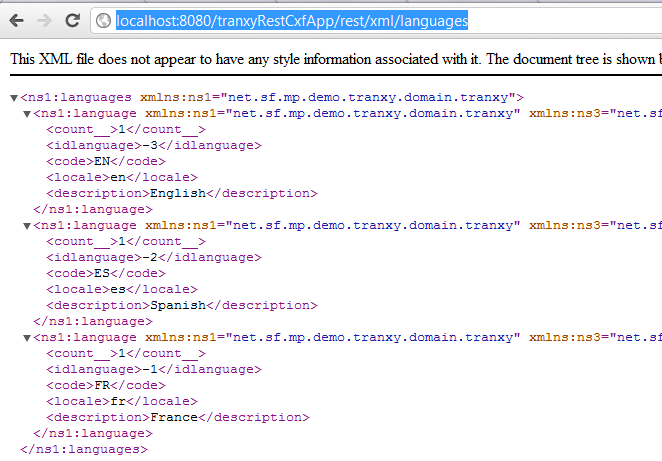
Now enter
http://localhost:8080/tranxyRestCxfApp/rest/xml/languages to get all the languages
This is the result
http://localhost:8080/tranxyRestCxfApp/rest/xml/users/-1 to get the first user
This is the result

Conclusion
This article presented you how to get quickly a CRUD REST interface on top of your DB model.
Of course, you may not need CRUD for all entities and may you need more coarse grain functions to manipulate your model.
Next article will present you how with Statement Driven Development we can get closer to Use Case.


